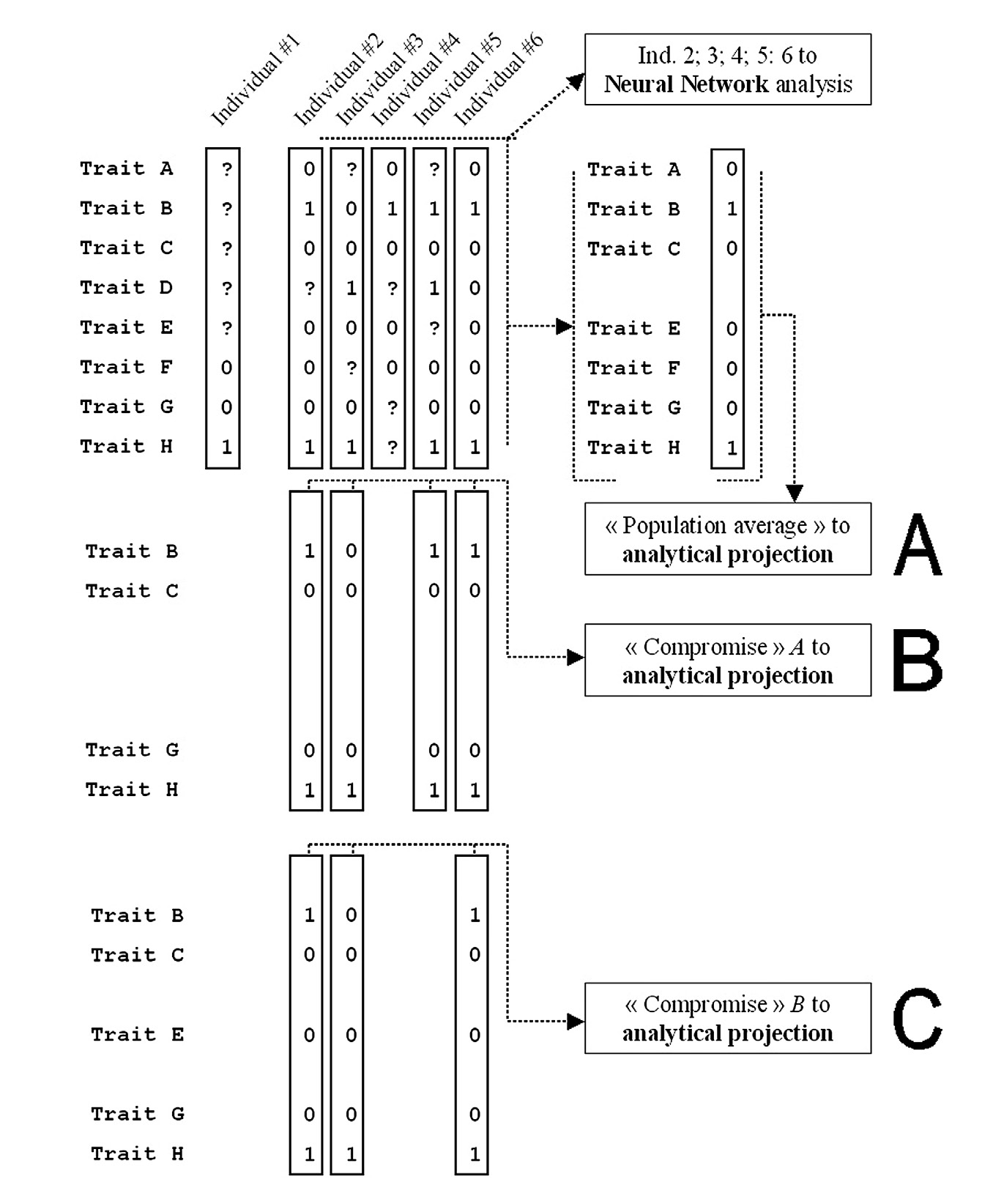
| Caption | Examples of data vectors defined by eight dental traits (A; B; C; D; E; F; G; H). On the top of the figure a dataset of 6 individuals is displayed and the descriptors correspond to the presence (1) or absence (0) of a given dental trait. Missing measures are reported as “?”. As all vectors present missing descriptors, we visually suggest the various strategies that are generally adopted to analyze them. In analytical projections (like MDS or PCA), no missing data can be processed, therefore individual samples can be converted in a population vector whose descriptors correspond to a majority rule consensus concerning available descriptors (case A). Otherwise, a compromise between the number of individuals or the number of observations that are kept for the analysis has to be achieved. In B there are 4 individual vectors (#2; #3; #5; #6) with 4 traits (B; C; E; G; H); in C there are less individuals (#2; #3; #6) with more descriptors defining them (B; C; E; G; H). Artificial Neural Network analysis can be used to process the full set. Please note that the vector corresponding to “Individual #1” has been excluded from analyses due to its too many missing descriptors. |